Media team
One episode, several people: a role for each, a track for each voice, and a release approved by a designated person.
Many hands, one episode
In a newsroom or a studio, one episode goes through several people: the one who prepares it, the ones who speak on mic, the one who edits, the one who approves the release. When each works in a separate tool, files travel by messaging app, versions multiply and nobody knows any more which one goes on air.
Roles and approval
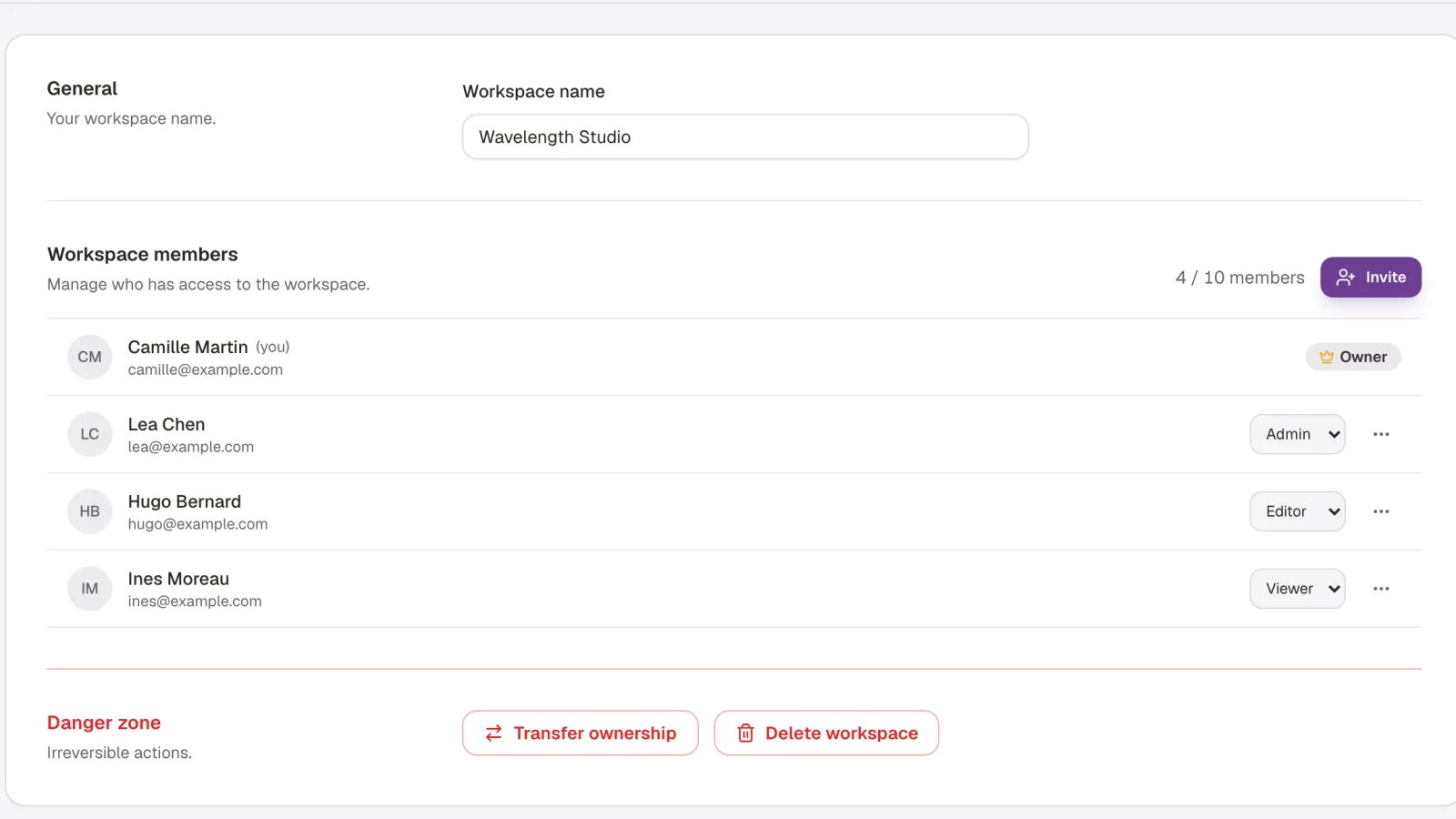
An organization groups its members under four roles. The viewer reads without changing anything. The editor creates episodes, records, edits and launches renders. The admin publishes, schedules a release date, handles distribution and manages members. The owner also holds billing.
Publishing is therefore reserved to the admin: an edit finished by an editor waits for approval before it reaches the feed.
Quotas belong to the organization, not to individuals. Storage, episodes, renders and AI credits are shared, on a single subscription.
Multi-voice sessions
The studio hosts several speakers at once, their number depending on the plan. Each one leaves with a separate track, so a single voice can be corrected in the edit without touching the others. Each participant is also recorded on their own machine, and that file uploads during the session: the quality recovered does not depend on the weakest connection in the group.
Before the start, the waiting room shows each microphone's level and who has marked themselves ready. During the recording, an internal chat carries cues and timing without appearing in the audio, and the preparation notes panel stays open beside the grid.
The soundboard belongs to the show. Jingles and stingers are trimmed and calibrated once, then triggered into the shared mix and captured during the session.
Shared editing
The episode project is a single document, saved continuously. Each track has eleven effects with their visual editors, and a master bus applies to the whole. The preview matches the export, because the two processing chains, in the browser and at render, are kept identical: a setting approved by one person does not change in a render launched by another.
Effect on the organization
One place holds the take, the edit and the published version. Each person's role decides what they can do, and the last step goes through a designated person.
Current gaps
The project opens for writing to one person at a time: other members find it locked until that person leaves. No history of actions is available to the organization. Listening statistics are not available yet. Roles and the number of members depend on the plan.
Related pages
Live studio, Multitrack editor, Internal podcast and Remote interview.